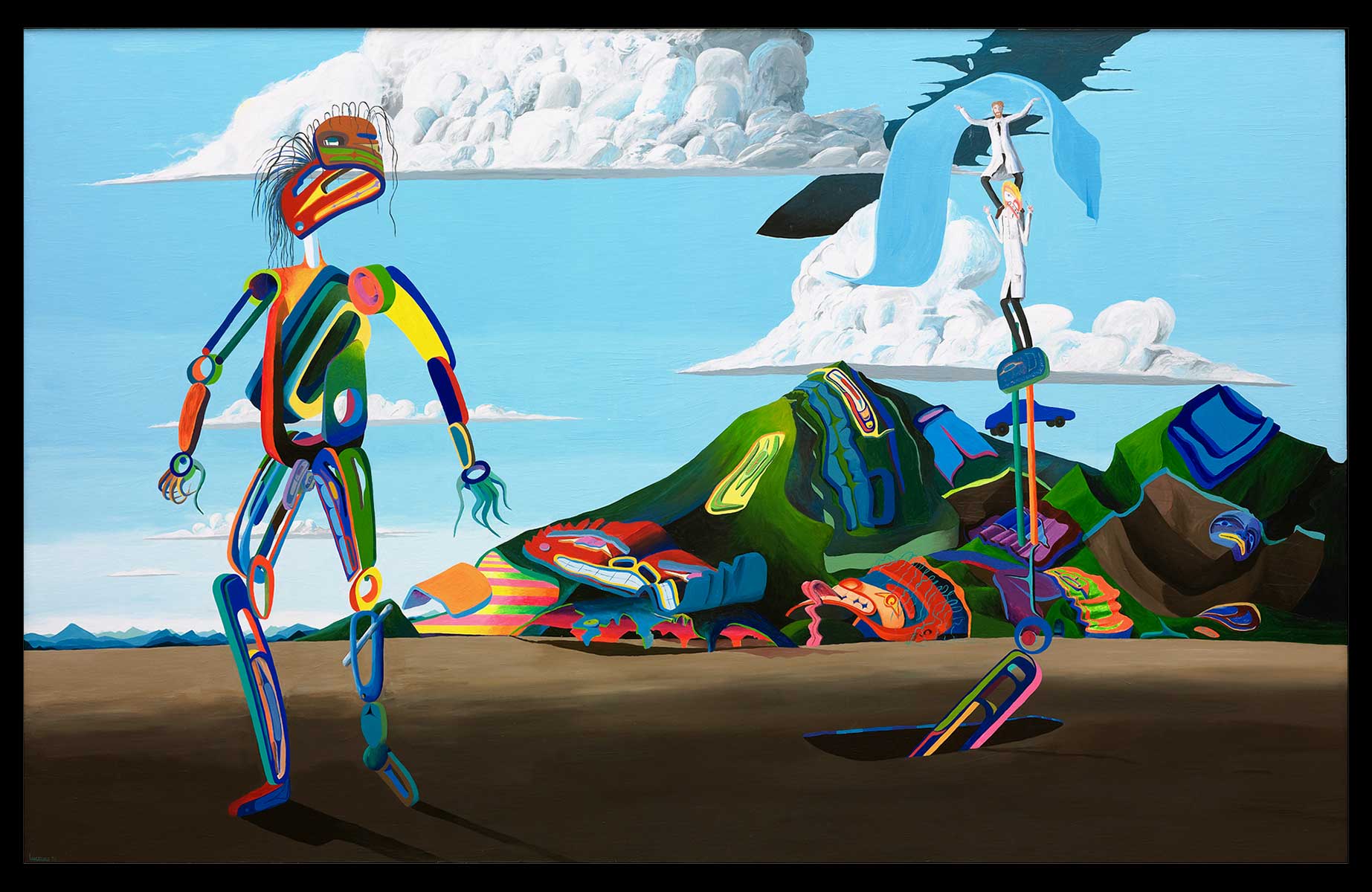
When exploring ideas of what to write about for this blog, my brain immediately went to art. I love art and it is the most powerful form of expression, especially when it comes to communication. Visual art allows the artist to convey messages and emotions without using words, the artist has the ability to puppeteer the viewer and make them feel what they want them to feel. In the case of my blog today, I came across an extremely innovative way to use technology with art. Unceded Territories is a virtual reality experience consisting of two indigenous artists’ work, a filmmaker and virtual reality director named Paisley Smith, and a painter named Lawrence Paul Yuxweluptun. Together they created an experience where you, the viewer, throw oil paint around your environment until you reach the end and realize the trail of destruction you have left along your path.
Unceded Territories VR- Trailer
Yuxweluptun states that his goal with this demonstration is to “teach people to love the land” (Yuxweluptun 2020), and reframe people’s thinking about indigenous rights and climate change, having people look the problem directly in the face simply and straightforwardly. The whole point of using visual communication in environmental communication is to reframe and change the perspective, to “construct or challenge a particular “seeing” of nature or what constitutes an environmental problem” (Pezzullo and Cox 132). Yuxwelupton and Smith do this by lulling people into a false sense of simplicity and fun, dropping people into a whimsical environment with fun tools you can use to spread paint, until you discover the consequences of your actions. Colonial oppression is something we still see to this day, people destroying environments with no regard for the harm they are causing, in fact, they often see what they are doing as good, “direct and indirect harms of settlers’ crisis-response actions have devastating impacts on Indigenous peoples across ancestral, living, and emerging generations” (Whyte 52). Once again, this experience blows my mind, the use of technology and art in environmental communication is an ever-changing and evolving sphere that continues to blow me away.
Sources
Guo, Demi, and Demi Guo. “Indigenous Artists Use Technology to Tell Stories about Their Ancestral Lands.” YES! Magazine, 23 Nov. 2020, www.yesmagazine.org/environment/2020/06/15/indigenous-artists-climate-technology.
Pezzullo , Phaedra, and Robert Cox. “Visual and Market Advocacy.” Environmental Communication and the Public Sphere, SAGE Publications, Inc, 2021, p. 132.
Whyte, Kyle. “Against crisis epistemology.”
Routledge handbook of critical Indigenous studies. Routledge, 2020. 52